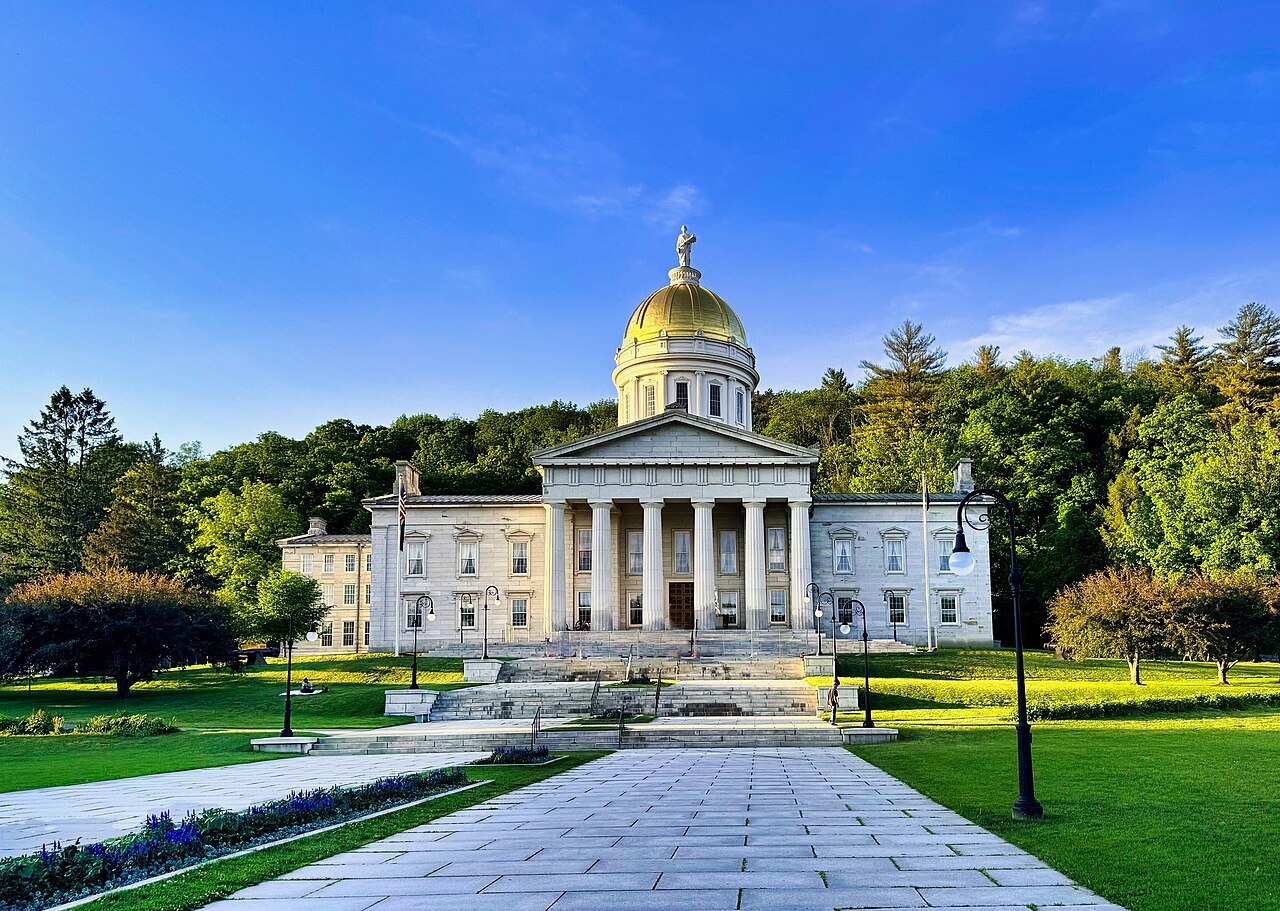
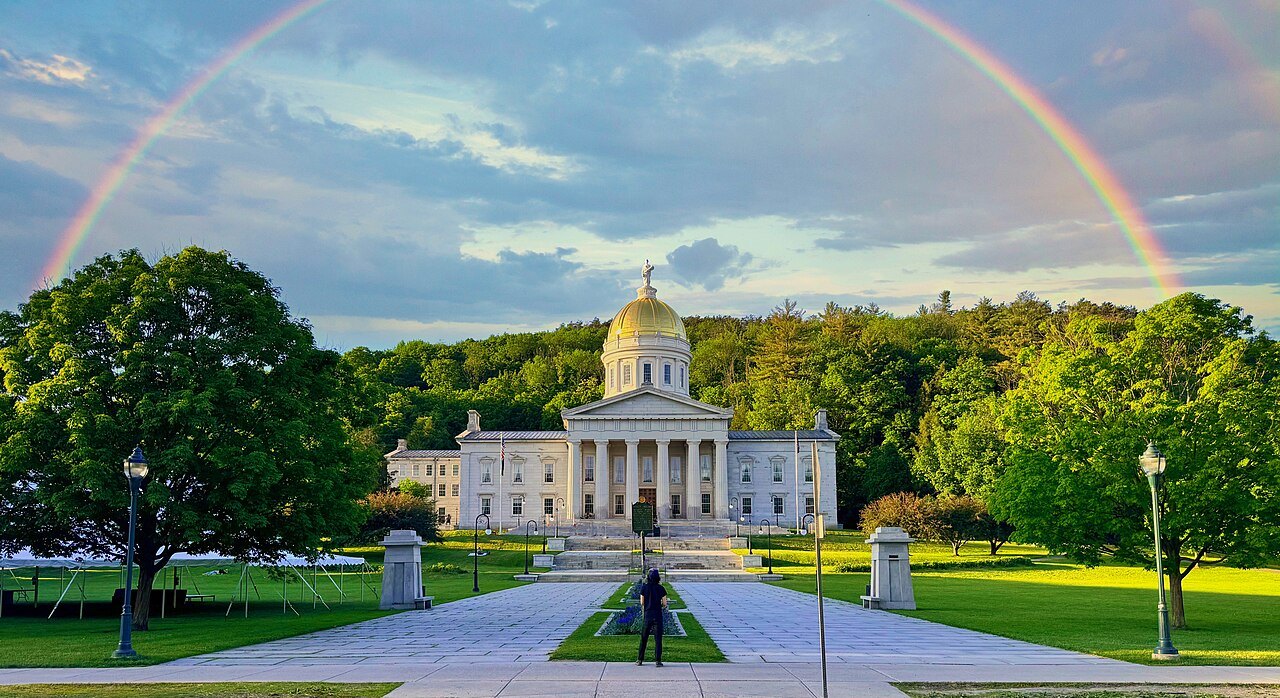
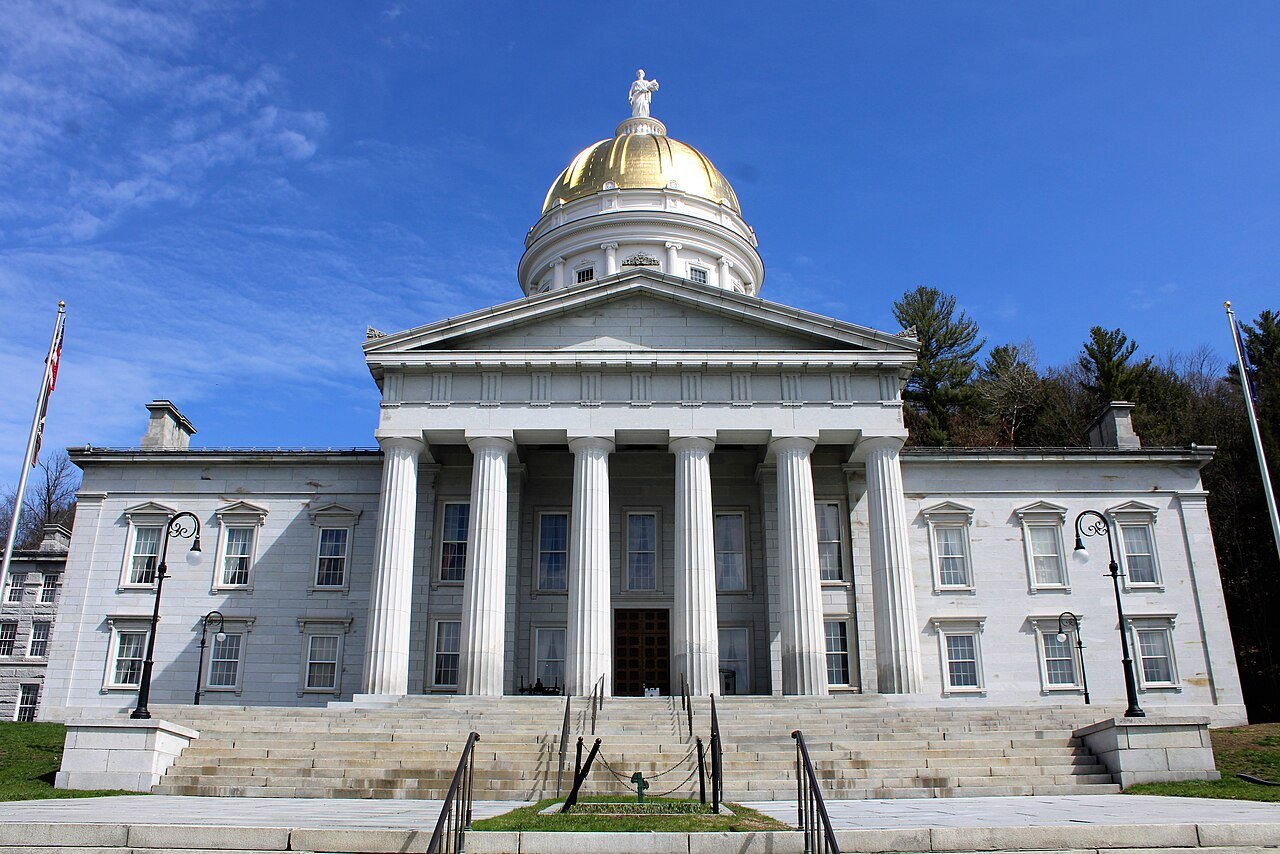
The Vermont State House, the smallest in the country under a gold-leaf dome
Photographs: Harrison Keely, Wikimedia Commons, CC BY 4.0 · Royalbroil, Wikimedia Commons, CC BY-SA 4.0 · Royalbroil, Wikimedia Commons, CC BY-SA 4.0
The Valleys and Villages · landmark 7 of 15
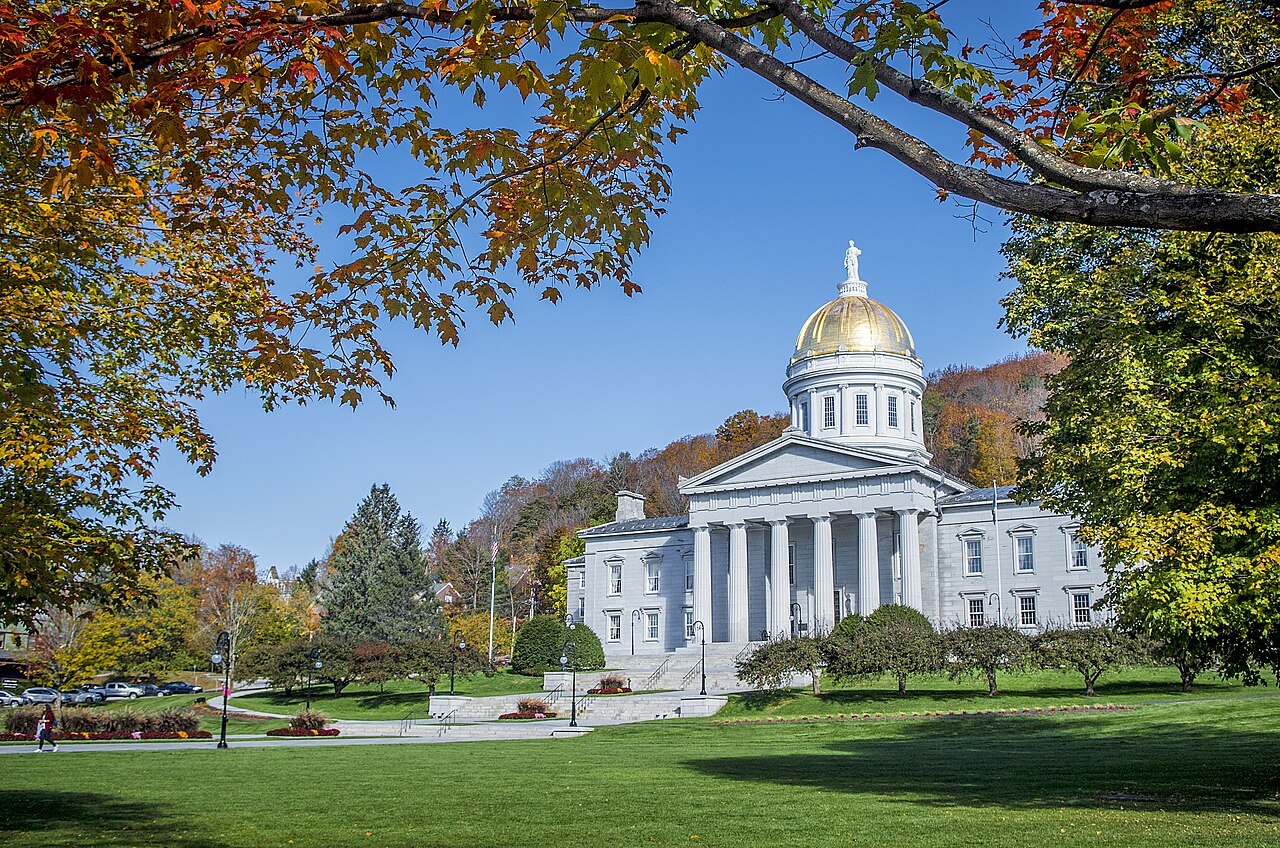
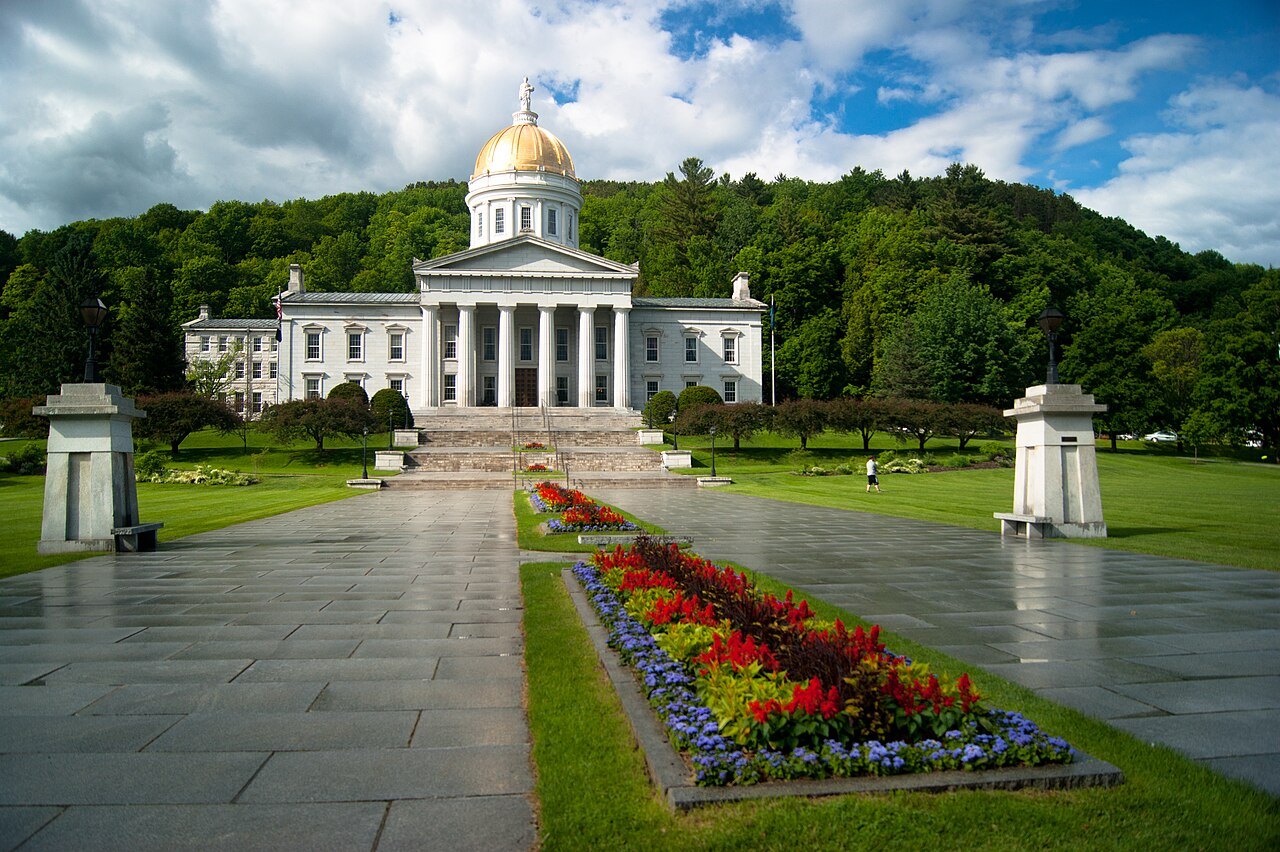
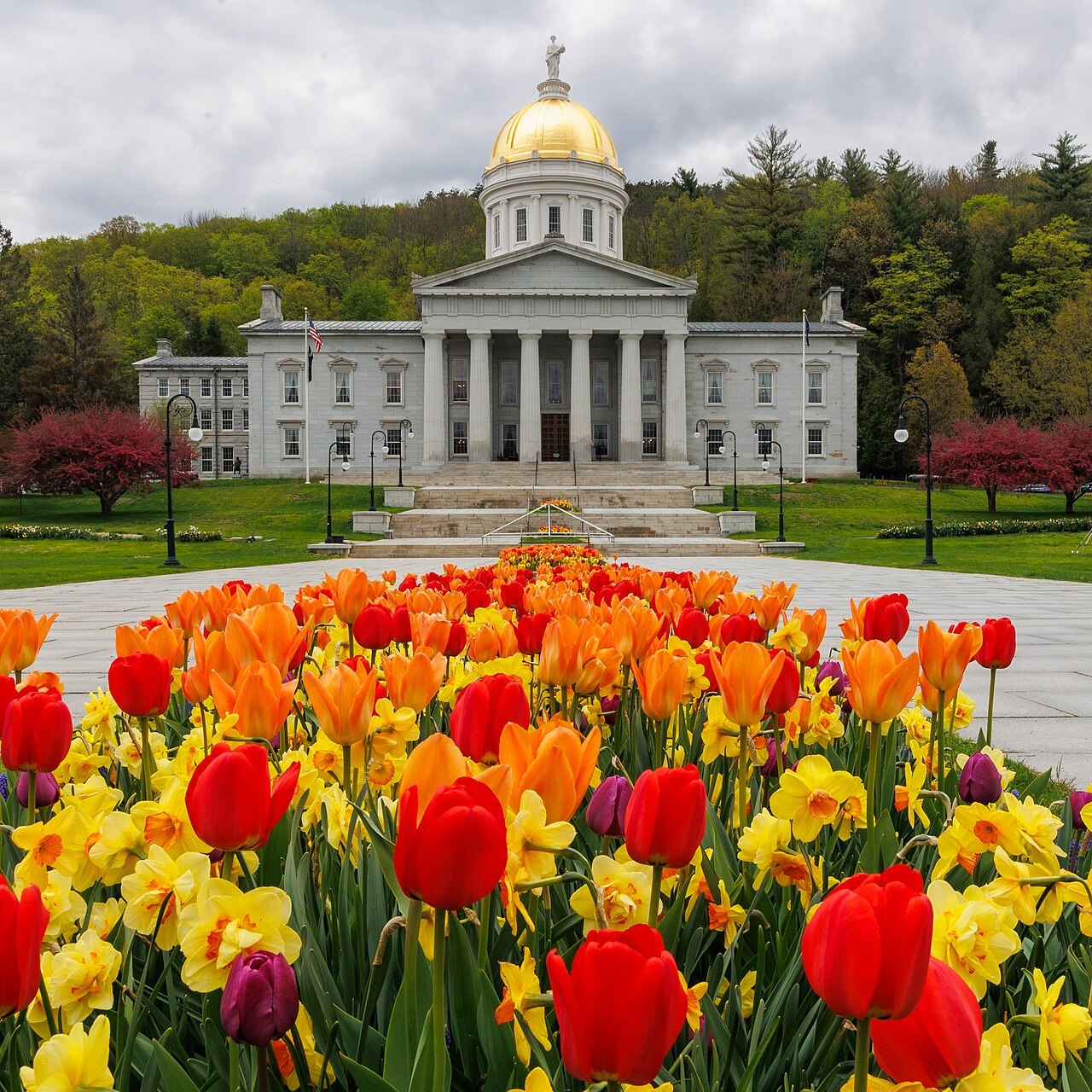
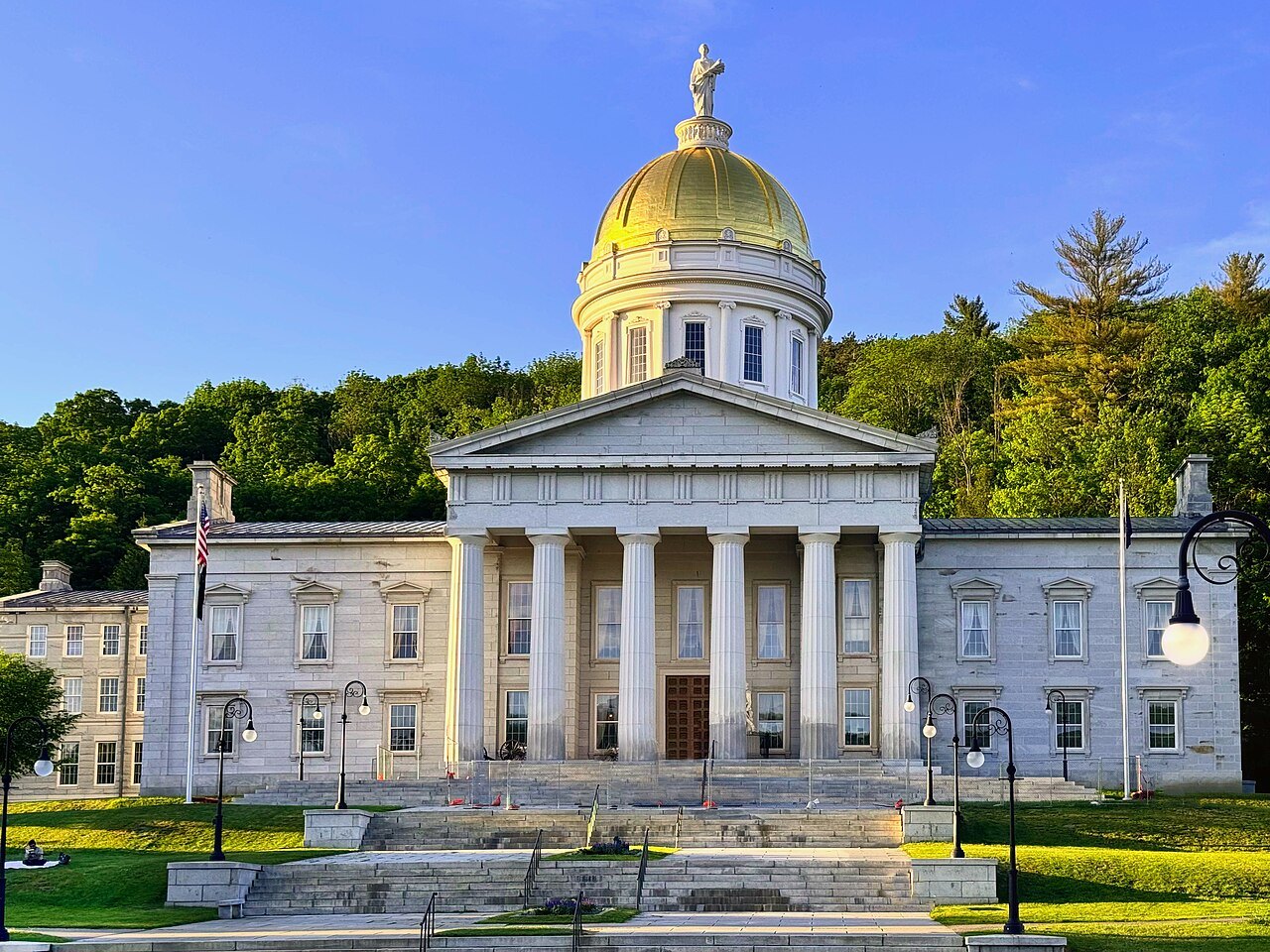
Occupied in 1859, the Greek Revival State House in Montpelier is the smallest state house in the United States, and its Barre granite portico and gold-leaf dome stand against a wooded hillside.
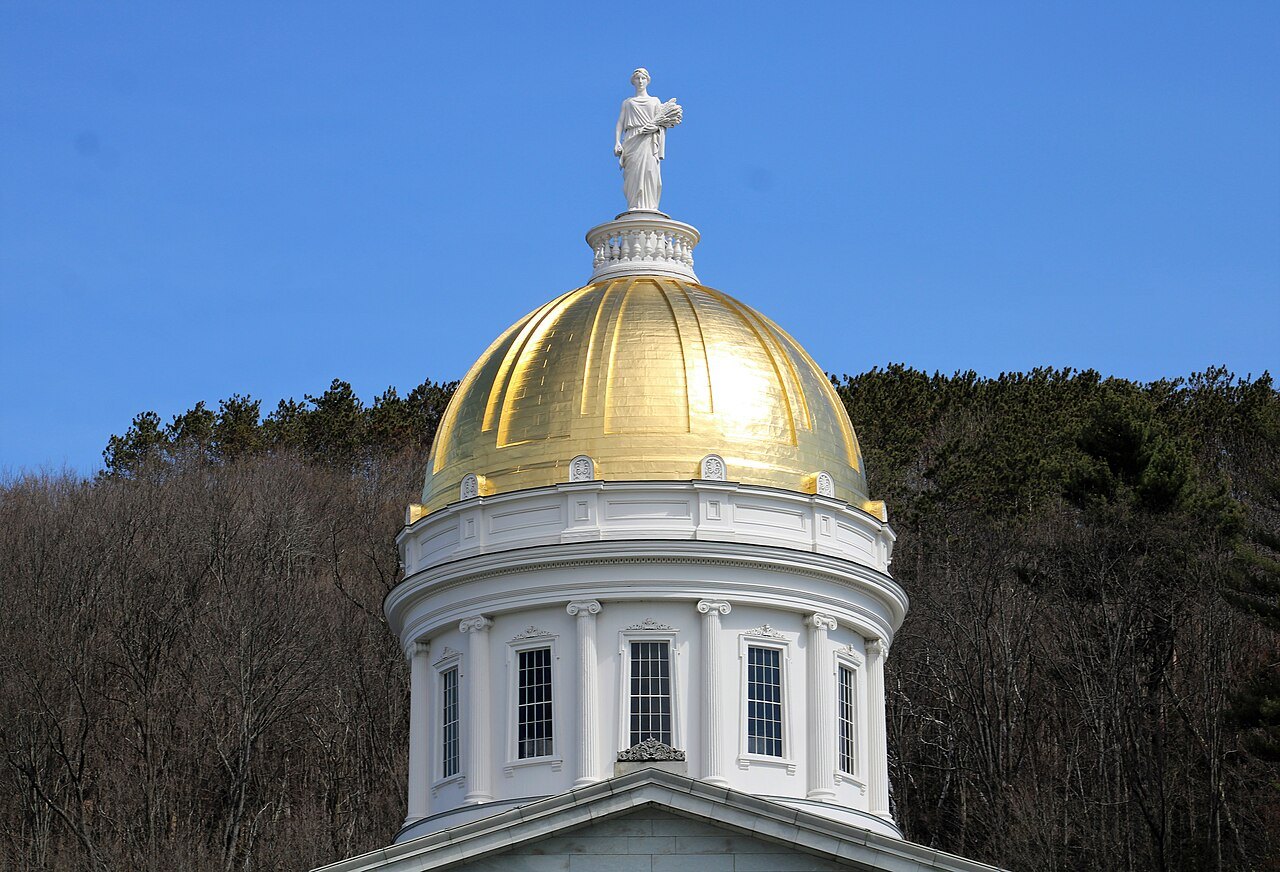
- The domeCopper on a wooden frame, gilded in the early twentieth century, topped by a statue of Ceres.
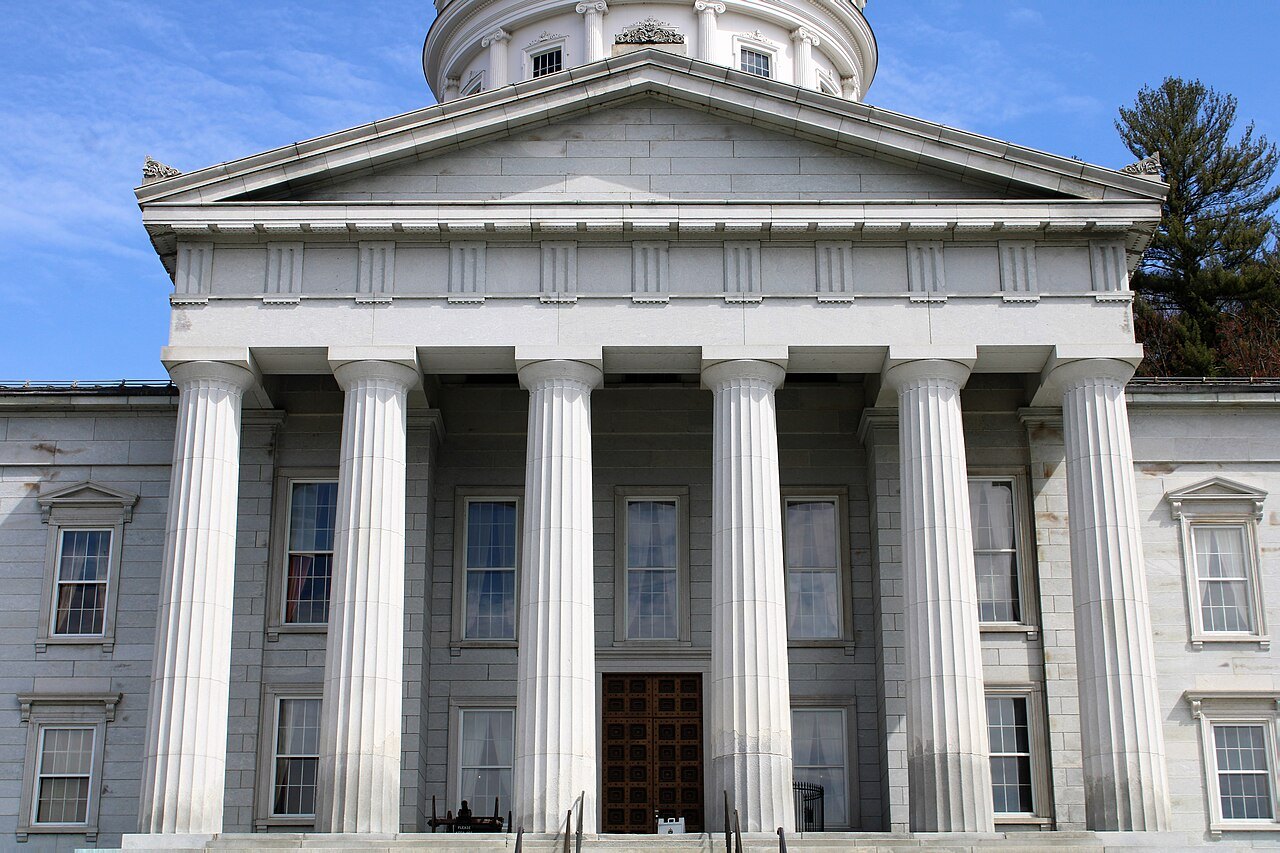
- The porticoA Doric portico of granite with a statue of Ethan Allen, carved in 1941.
- The Hall of InscriptionsEight marble tablets quoting Vermont's constitution and writers, each with fourteen gilded stars.
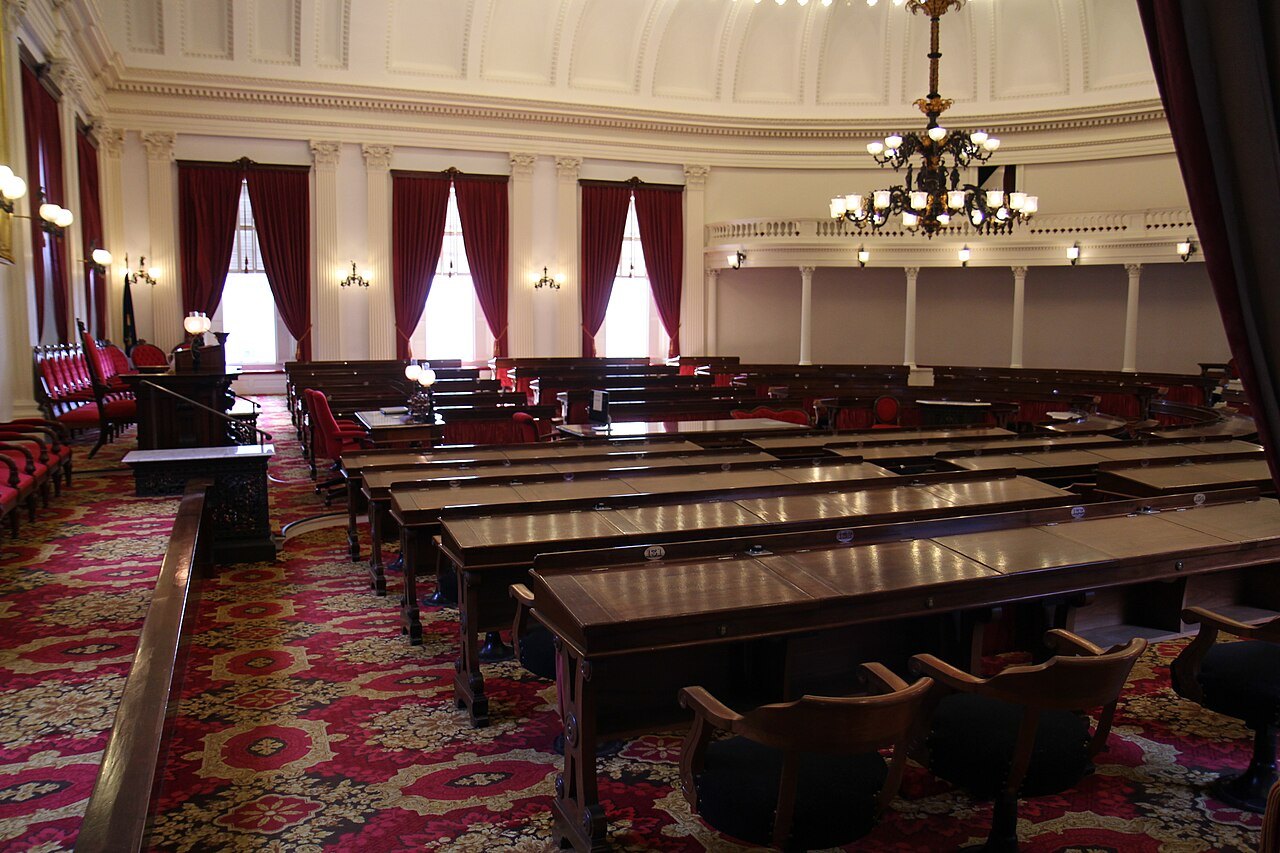
- Representatives HallUnder the dome, with a large chandelier and a portrait of Washington that survived the fire.
- The Cedar Creek RoomA reception room with a mural of the Civil War battle, painted in 1874.
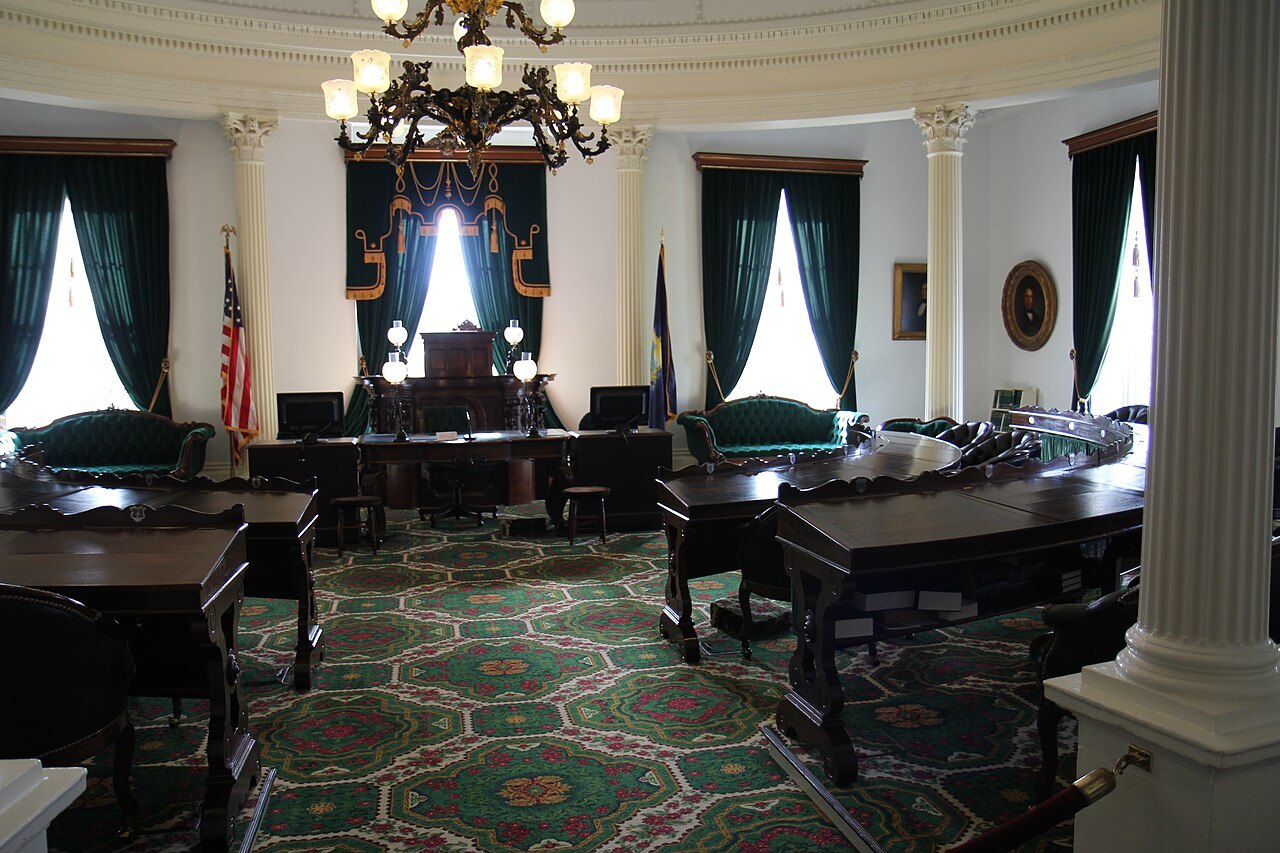
- The Senate chamberThirty black walnut chairs from 1859 are still in use.
Why it matters
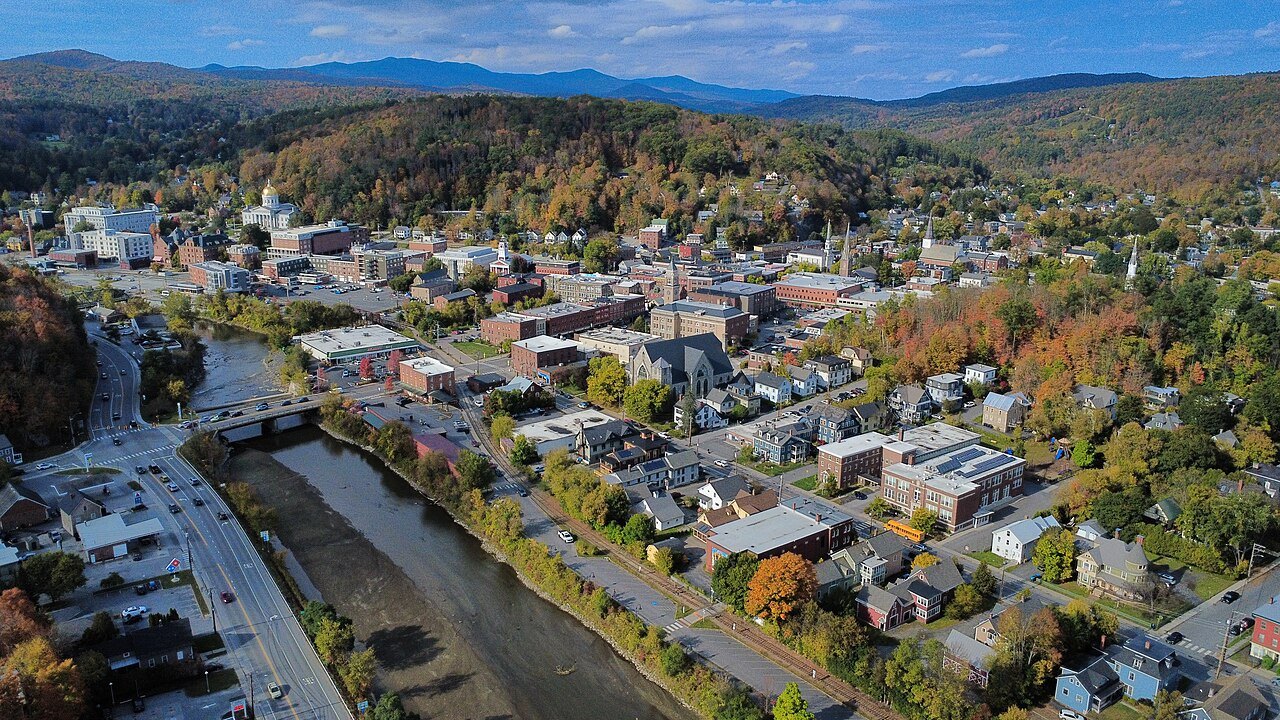
The Vermont State House stands on State Street on the western edge of downtown Montpelier, a block north of the Winooski River, set against a wooded hillside that was open pasture for much of its history. It is the seat of the Vermont General Assembly, and the current Greek Revival building is the third on the site. It was designed by Thomas Silloway in 1857 and 1858 and occupied in 1859. It is the smallest state house in the United States, in the smallest city to serve as a state capital.
Its gold-leaf dome is easy to see on the approach to the city, and the building is known as the People's House, a nickname that reflects Vermont's reputation for popular government.
Three buildings on one hill
The first State House was built in 1808 by Sylvanus Baldwin and was replaced by the present Vermont Supreme Court Building, completed in 1918. The second, built between 1833 and 1838, was a restrained Greek Revival design by Ammi B. Young, who later became supervising architect of the United States Treasury. It was based on the Temple of Hephaestus in Athens, built of gray Barre granite with a Doric portico and a low saucer dome. A fire in January 1857 almost entirely destroyed it.
Silloway salvaged the Doric portico and portions of the granite walls. He added an extra bay of windows on each side of the portico and raised the dome, which is copper over a wood frame, to its present height, perhaps to match the taller new dome then going up on the Capitol in Washington. The architect Stanford White considered Silloway's building the finest example of the Greek Revival style in the United States.
The dome and the goddess
The dome and roofs were first painted a dark terracotta red, to suggest Tuscan tile. The dome was not gilded until the early twentieth century, when many states did so as part of the Colonial Revival style. It is topped by a statue named Agriculture, a figure of Ceres, the Roman goddess of agriculture. Vermont sculptor Larkin Goldsmith Mead carved the first, installed in 1858. When that one rotted, a replacement was carved in 1938 by Dwight Dwinell, then eighty-seven and the Sergeant-at-Arms. The second statue was removed in April 2018 and replaced by one carved by Chris Miller from a laminated block of mahogany.
Below it, the portico shelters a granite statue of Ethan Allen, founder of Vermont and commander of the Green Mountain Boys during the Vermont Republic. Aristide Piccini carved it in 1941 to replace Mead's original marble figure of 1858.
Inside
Two circular stairways rise from the ground-floor Cross Hall to two main floors. The Entrance Hall is in the Greek Ionic order, with portraits of Presidents Calvin Coolidge and Chester A. Arthur, both natives of Vermont, and a portrait of Admiral George Dewey of Montpelier on his flagship at Manila Bay. The tall front doors were painted and coated with metallic powder in 1859 to look like bronze.
The principal public room is the Hall of Inscriptions, a corridor of Doric pilasters with eight marble tablets incised with quotations about Vermont's culture and heritage. They quote the Vermont Constitution, Ethan Allen, Calvin Coolidge, George Aiken, Warren Austin and Dorothy Canfield Fisher, among others, and each carries fourteen gilded stars for Vermont's fourteen counties and its fourteen years as an independent republic. There is no rotunda: the dome sits almost directly above the ceiling of Representatives Hall.
The chambers
The two chambers of the General Assembly are on the second floor. Contrary to the tradition of a red upper house and a green lower house, Vermont keeps green and gold for the Senate and uses red and gold for the House of Representatives. A large plaster ceiling medallion in the shape of a lotus holds a two-tiered gasolier made in Philadelphia, and each petal of the rosette weighs about 500 pounds. Axminster carpets in both chambers were recreated from old stereoscope views and scraps found in an attic.
Visitors can enter quietly and sit on the main floor of the chambers, and overhead galleries on a third-floor mezzanine look down into both. Most of the furnishings date from the 1859 reconstruction, including the thirty black walnut chairs in the Senate, still used for the same purpose. Only the large portrait of George Washington, painted around 1837 after Gilbert Stuart, survived the fire of 1857 and hangs above the speaker's chair.
The Cedar Creek Room and the governor's rooms
On the second floor of the west wing the Cedar Creek Room is a large reception room with a mural by Julian Scott, painted in 1874, that fills much of the south wall. It shows the Civil War Battle of Cedar Creek and the part Vermont troops played in it. Two stained glass skylights from 1859 were found broken and stacked in the attic in 1970, and they were reassembled and reinstalled in the mid-1980s.
The governor's ceremonial office, used during legislative sessions, is in the west wing and has been restored to its 1859 appearance. The working office and private apartments are nearby at The Pavilion, a Second Empire building just east of the Supreme Court. Portraits of governors, among them Howard Dean shown in a canoe, hang along the corridors.
A working public building
From its beginnings the State House has also worked as a living museum and cultural facility. Visitors are welcome with remarkably few restrictions whether or not the legislature is in session. During the winter, evening concerts called Farmers Nights are held in Representatives Hall, and in warmer weather the public lawn on the south side hosts concerts by the Vermont Symphony Orchestra and by municipal bands from around the state, and serves as a place for residents to sit, eat and play.
The lawn and the portico steps are also a well-used platform for peaceful demonstrations, press conferences and the formal welcome of official visitors to the state. A careful restoration began in the early 1980s under the curator David Schütz and the Friends of the Vermont State House, and the work on the building and its grounds has continued since 1994 under the state architect Tricia Harper.
Seeing it
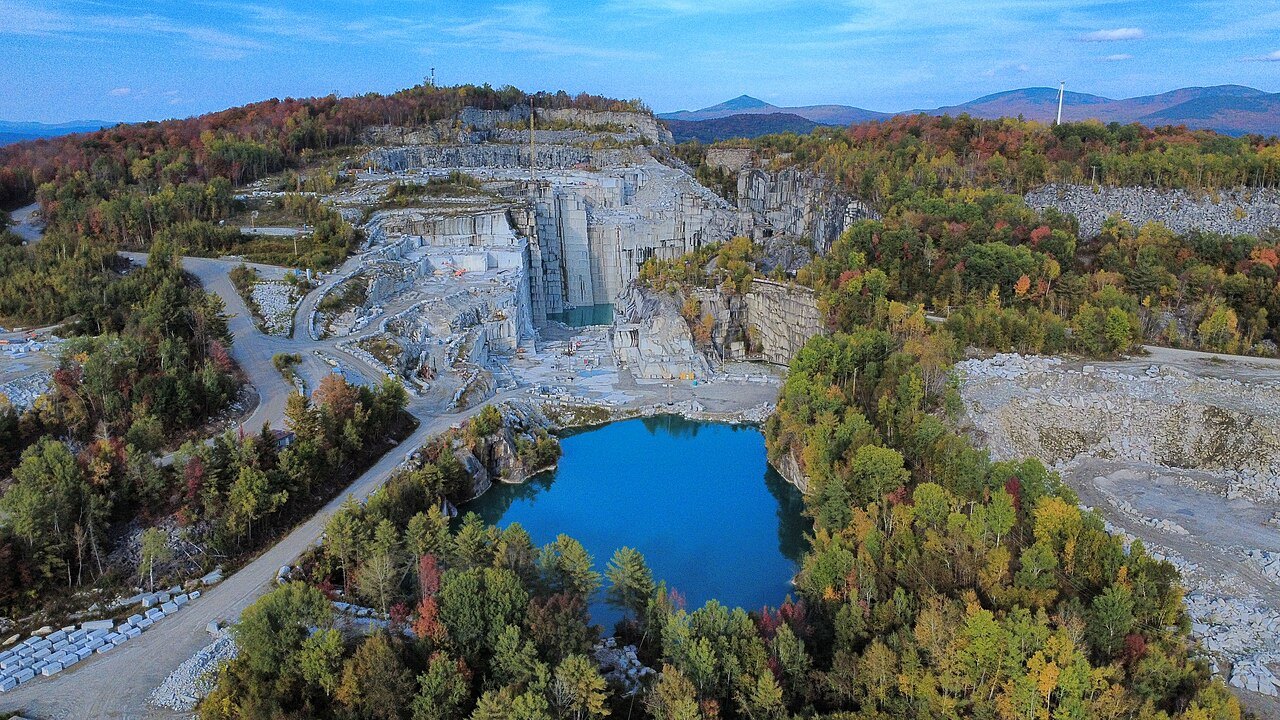
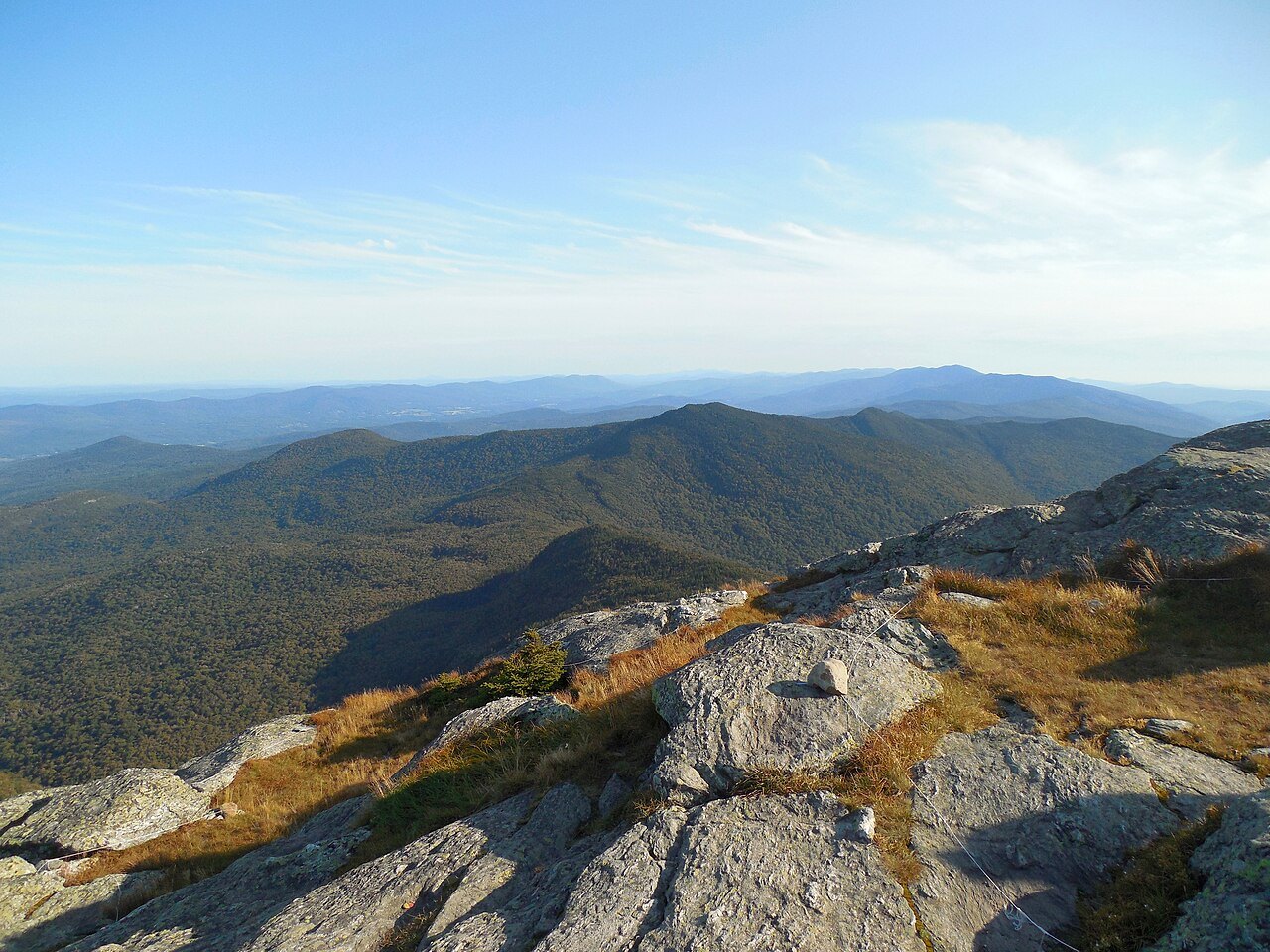
The State House is a short walk from the rest of downtown Montpelier, so it fits easily into a visit to the town. For the quarry that supplied its granite, see Barre and the granite quarries, a short drive away. The gold dome also makes a good landmark from the hills around the city, and Camel's Hump is the nearest big summit.